
The first snowy morning of the season always catches some drivers by surprise.
The road looks familiar, but the car no longer stops, turns or accelerates the way it did a week earlier.
Driving on snow and ice is a skill, and like any skill it improves with a few clear rules.
This guide covers how to drive on slick roads, what to do the moment the car starts to slide and how to stay safe if you get stuck.
Why winter roads are so dangerous
The National Weather Service states that more than 5,000 fatalities occur on the roadways each year due to weather conditions.
Snow and ice take away the one thing every maneuver depends on: grip between the tires and the road.
With less grip, stopping distances grow longer and the car is more likely to slide when you turn or brake.
The worst surfaces are often the ones that look harmless.
The NWS warns that even if the roads just look wet, they could still be slick.
Rule 1: Slow down
The NWS puts it in two words: slow down.
Speed is the factor you control most directly, and it affects everything else.
At a lower speed you have more time to see a problem, and the car needs less distance to stop.
Slow down well before curves, intersections, bridges and overpasses rather than braking in the middle of them.
FuelEconomy.gov notes that safe driving speeds on slick roads can be much lower than normal.
That is expected, and it is the right trade.
Rule 2: Be gentle with every input
On snow and ice, sudden movements are what break the tires loose.
- Accelerate gently. Press the gas pedal slowly so the wheels do not spin.
- Brake early and smoothly. Start slowing sooner than you would on dry pavement.
- Steer smoothly. Turn the wheel in one steady motion instead of jerking it.
Imagine there is a cup of coffee on the dashboard that you do not want to spill.
That is roughly the right touch.
Rule 3: Leave much more space
Your following distance needs to grow along with your stopping distance.
Give the car ahead far more room than you would in summer.
Extra space is the difference between a calm stop and a collision when the driver in front brakes suddenly.
It also gives you room to steer around a problem instead of sliding straight into it.
What to do if the car starts to skid
Even careful drivers sometimes feel the rear of the car slide or the front stop responding to the steering.
The NWS guidance for a skid is clear.
- Remain calm. Panic leads to sharp movements that make the slide worse.
- Ease your foot off the gas. Do not stomp on the brake.
- Steer where you want to go. Turn the wheels in the direction you want the front of the car to go.
Look where you want the car to end up, not at the ditch or the pole you are worried about.
Your hands tend to follow your eyes.
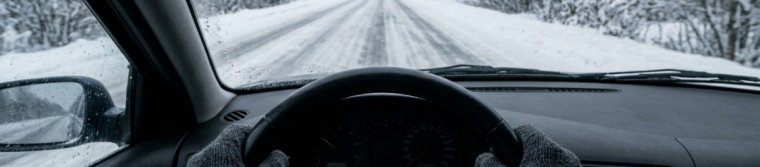
As the tires regain grip, straighten the wheel gradually so the car does not swing the other way.
Braking with and without ABS
Most modern cars have an anti-lock braking system, usually called ABS.
The NWS advice for these cars is to apply steady pressure to the brake pedal.
Never pump the brakes on a vehicle equipped with ABS.
The system pumps the brakes for you, many times per second, so the wheels keep turning and you can still steer.
You may feel the pedal pulse and hear a grinding or buzzing sound.
That is normal, so keep firm, steady pressure on the pedal.
If you are not sure whether your car has ABS, check the owner's manual.
It also explains what the system feels like in your vehicle.
Before you leave the driveway
A safe winter drive starts before you shift into gear.
The NWS says to make sure your vehicle is completely clear of ice and snow before starting the trip, because flying snow from cars causes accidents.
- Clear every window, mirror and light, plus the roof and hood.
- Let someone know where you are going and what route you will take.
- Carry a fully charged mobile phone, a car charger and an emergency supplies kit.
Our guide on how to get your car ready for winter covers the full kit and the checks to do in the fall.
When you cannot see
Blowing snow can drop visibility to almost nothing in seconds.
If you are having trouble seeing, the NWS advises pulling over to the side of the road and stopping until visibility improves.
Once stopped, turn off your lights and use your parking brake.
That way another driver will not mistakenly follow your taillights or brake lights and end up hitting you.
The same logic applies in heavy fog. Our guide on driving in fog explains it in more detail.
If your car gets stuck in a storm
Getting stuck in snow is frightening, but the NWS guidance is simple and it saves lives.
The most important rule is to stay in the vehicle.
If you leave the car, you can become disoriented quickly in wind-driven snow and cold.
While you wait for help, the NWS recommends the following.
- Run the motor about 10 minutes each hour for heat.
- Open a window a little while the motor runs to let in fresh air and avoid carbon monoxide poisoning.
- Clear snow from the exhaust pipe before running the engine, to avoid gas poisoning.
- Turn on the dome light at night when the engine is running, so rescuers can see you.
- Tie a bright cloth, preferably red, to the antenna or door.
- Raise the hood after the snow stops falling to show you need help.
Move your arms, legs, fingers and toes from time to time to keep blood flowing.
The NWS also warns against overexertion, such as pushing a car or shoveling heavy snow, if you are not in good health.
Fuel and four-wheel drive
Winter driving uses more fuel, so plan for it.
FuelEconomy.gov notes that icy or snow-covered roads reduce your tires' grip and waste energy, and that using four-wheel drive uses more fuel.
The NWS recommends keeping the gas tank near full in winter.
A full tank also means more hours of heat if you get stuck.
Four-wheel or all-wheel drive helps a car get moving on snow, but it does not help it stop or turn any better.
Drive a four-wheel-drive vehicle with the same caution as any other car.
A quick winter driving checklist
- Clear all snow and ice from the car before you leave.
- Slow down, especially on bridges, overpasses and curves.
- Accelerate, brake and steer gently.
- Leave much more following distance.
- In a skid, ease off the gas and steer where you want to go.
- With ABS, press the brake firmly and steadily.
- If stuck, stay with the car and keep the exhaust pipe clear.
The bottom line
Driving on snow and ice comes down to speed, smoothness and space.
Slow down, make every movement gentle and leave room to stop.
If the car slides, stay calm and steer where you want to go.
If the storm gets the better of you, stay with the car and wait for help.
Sources and Further Reading
- National Weather Service: What To Do If You're Caught in a Winter Storm — supports the weather-related fatality figure, slowing down, clearing the car, skid recovery, ABS braking, stopping in low visibility and every step for a car stuck in a storm.
- National Weather Service: Prepare! Don't Let a Winter Storm Take You by Surprise — supports keeping the gas tank near full.
- FuelEconomy.gov: Fuel Economy in Cold Weather — supports lower safe speeds on slick roads, lost grip wasting energy and four-wheel drive using more fuel.