
Parking is the part of driving that most people learned once and never thought about again.
Then they face a steep street, a tight space or a curb painted a color they do not recognize.
Parking mistakes rarely cause serious crashes, but they do cause tickets, towing and dented bumpers.
A car that rolls away on a hill can also cause real harm.
This guide covers the parking skills that matter most for everyday drivers.
The rules come from the California Driver Handbook.
Curb colors and distances can vary by state and city, so always read local signs.
Parking on a hill: turn your wheels the right way
A parked car can roll if a part fails, even with the transmission in park.
The California Driver Handbook says to set the parking brake every time you park on a hill.
Leave an automatic in park, or leave a manual transmission in gear.
Then turn your front wheels so the curb or the roadside will stop the car if it rolls.
Headed downhill
Turn your front wheels into the curb, or to the right toward the side of the road.
If the car starts to roll forward, the front tire runs into the curb and stops.
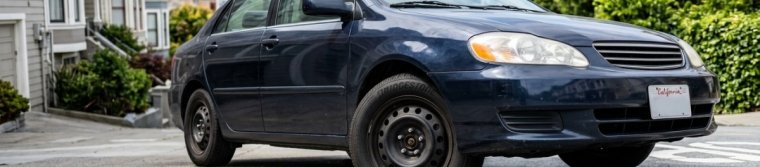
Headed uphill with a curb
Turn your front wheels away from the curb, toward the center of the road.
Then let the car roll back a few inches.
The back of the front tire should gently touch the curb.
If the car rolls backward, the curb catches the tire.
No curb, uphill or downhill
Turn the wheels to the right.
That way, a rolling car moves away from the center of the road and away from traffic.
A sloping driveway
Turn the wheels so the car will not roll into the street.
Leave it in park and set the parking brake.
An easy way to remember
Ask yourself one question before you turn off the engine.
If this car rolled, where would it go?
Point the wheels so the answer is the curb or the side of the road, never the traffic lane.
Parallel parking in five steps
Parallel parking means parking in line with the road, between other parked cars.
It feels hard because most of the move happens in reverse.
A simple routine makes it repeatable.
- Find a space. Look for a space at least three feet longer than your car. Turn on your signal.
- Pull up alongside the car in front of the space. Leave about two feet between the two cars. Stop when your rear bumper lines up with the front of the space.
- Check your blind spots. Look in your mirror and over your shoulder for cars, bicycles and pedestrians.
- Back up at an angle. Turn the steering wheel and back into the space at about a 45-degree angle.
- Straighten out. When your rear wheel is within 18 inches of the curb, turn the wheel away from the curb. Pull forward or back as needed.
You should end up parallel to the curb and within 18 inches of it.
Turn off the car and set the parking brake.
Getting out safely
The parallel parking job is not done until you are out of the car safely.
Before you open your door, look carefully for passing cars, bicycles and motorcycles.
The handbook's safe driving section lists opening your door as a moment to check blind spots.
A door opened into a cyclist's path can cause a serious crash.
Our guide to sharing the road with motorcycles and bicyclists explains why this check matters.
Practice tips
- Practice on a quiet street with one parked car before trying a busy block.
- Use the mirrors and your shoulder check, not only the backup camera.
- Move slowly. Speed is the main reason for scraped wheels.
- If the angle is wrong, pull out and start again. There is no penalty for a second try.
Backing in a straight line
Straight-line backing is a skill many driving tests include.
It also helps on long driveways and narrow alleys.
- Check traffic and your blind spots first.
- Look in your mirror and over your shoulder for people and vehicles.
- Back slowly in a straight line, making small steering corrections.
- Keep looking behind you the whole time.
A smooth, slow speed gives you time to react.
What curb colors mean
Painted curbs tell you what you can do at that spot.
The handbook lists these meanings:
- White: Stop only long enough to pick up or drop off passengers.
- Green: Park for a limited time. The limit may be posted on a sign or painted on the curb.
- Yellow: Load and unload passengers or freight, only for the time posted. Drivers of regular cars usually must stay with the car.
- Red: No stopping, standing or parking. Buses may stop at red zones marked for buses.
- Blue: Parking for a disabled person, or someone driving them, with a special placard or license plate.
When a sign and a curb color seem to disagree, follow the more restrictive rule and look for more signs.
Places you can never park
Some spots are off limits even when the curb is unpainted.
According to the handbook, never park or leave your car:
- Where a no parking sign is posted.
- On a marked or unmarked crosswalk.
- On a sidewalk, partly blocking a sidewalk or in front of a driveway.
- Within three feet of a sidewalk ramp for disabled persons.
- In the striped area next to a disabled parking space.
- Within 15 feet of a fire hydrant or a fire station driveway.
- Within 20 feet of a crosswalk.
- In a tunnel or on a bridge, unless signs allow it.
- Double parked, or on the wrong side of the street.
- In a space for charging electric vehicles, unless you drive one.
The fire hydrant rule exists for a simple reason.
Firefighters need to reach the hydrant within seconds.
Stopping on a freeway
Parking on a freeway is only allowed in an emergency or when an officer tells you to stop.
If you must stop, the handbook says to park completely off the pavement.
Stay in your car with the doors locked until help arrives.
A car left on a freeway for more than four hours may be removed.
Our article on emergency vehicles and move over laws explains how other drivers should treat stopped cars.
A quick checklist
- On any hill, set the parking brake.
- Downhill: wheels toward the curb.
- Uphill with a curb: wheels away from the curb, then roll back gently.
- No curb: wheels to the right.
- Parallel park within 18 inches of the curb.
- Check for bicycles before opening your door.
- Learn the five curb colors and the no-parking distances.
The bottom line
Good parking is mostly about patience and a few simple rules.
Turn your wheels the right way on hills, follow a steady routine when parallel parking and read the curb before you leave.
Those habits save you from tickets, towing and the worst surprise of all: a car that rolls away.
Sources and Further Reading
- California DMV: California Driver Handbook, Section 6, Navigating the Roads (Continued) — supports the hill parking rules, the parallel parking and straight-line backing steps, the curb colors, the illegal parking list and stopping on a freeway.
- California DMV: California Driver Handbook, Section 8, Safe Driving — supports checking your blind spots before parallel parking, pulling away from the curb and opening your car door.