
Most road trip injuries are small.
Someone scrapes a knee at a trailhead, gets a blister on a long walk or cuts a finger while making lunch.
Small problems are easier to handle when the right supplies are already in the car.
A first aid kit takes little space and saves a stop at a pharmacy that may be an hour away.
This guide explains what to pack, how to keep the kit useful and when a problem needs real help.
It is based on guidance from MedlinePlus, the health information service of the National Library of Medicine.
It is general information, not medical advice.
What first aid is, and what it is not
MedlinePlus describes first aid as the care you give right away for an injury or sudden illness.
It is what you do before medical help arrives.
Knowing basic first aid, and when to call 911, helps you stay calm and act quickly.
A kit does not replace a doctor, an urgent care clinic or an ambulance.
It covers the small things and helps you bridge the gap until help arrives for the big ones.
Keep a kit in the car, not just at home
MedlinePlus says it is a good idea to keep a first aid kit at home and in your car.
On a road trip, the car is your home base for days at a time.
Kits come in many types and sizes.
Some are built for travel, workplaces or sports, and they include more supplies than a basic kit.
You can also build your own and add personal items.
The basic supplies
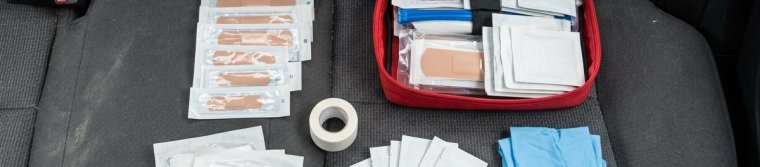
MedlinePlus lists the items a basic first aid kit should include.
- Adhesive bandages in several sizes.
- Sterile gauze pads.
- Adhesive tape.
- Antiseptic wipes.
- Disposable gloves.
- Scissors.
- A first aid guide, so you know how to use each item.
That guide matters more than it seems.
In a stressful moment, a short printed guide is easier to follow than a search on a weak phone signal.
Extras that make sense on a long drive
A road trip adds hours of driving, outdoor stops and places with no store nearby.
A few extras fill the gaps.
- Personal medicines. Pack enough for the whole trip, plus a few extra days in case of delays.
- Emergency phone numbers. MedlinePlus suggests adding them to your kit, written on paper.
- Blister care. Grand Canyon National Park includes blister care in the first aid kit on its summer hiking list.
- A flashlight and spare batteries. Injuries are harder to see and treat after dark.
- Extra water. It is useful for rinsing a wound as well as for drinking.
- Hand sanitizer. It helps when there is no sink at a remote pullout.
Ask a pharmacist before the trip about any over-the-counter medicine you plan to carry.
This is especially important for children or for anyone who takes other medicines.
Where to store the kit
A kit only helps if you can find it fast.
- Keep it in the same place on every trip, such as behind a seat or in a door pocket.
- Do not bury it under luggage in the trunk.
- Make sure every adult in the car knows where it is.
- Keep a smaller kit in the day pack you carry on walks.
Heat inside a parked car can be extreme in summer.
Medicines are best kept out of direct sun and moved inside with you at night.
Read the storage directions on each medicine label.
Check the kit before every trip
MedlinePlus advises checking the kit regularly and replacing expired items.
A pre-trip check takes five minutes.
- Look at expiration dates on medicines and ointments.
- Refill the bandages and gauze you used on the last trip.
- Replace gloves that are torn or stuck together.
- Test the flashlight and change old batteries.
- Update the paper list of emergency numbers.
Do this at the same time as your pre-trip car check, so it becomes part of the routine.
Cuts and scrapes on the road
Cuts and scrapes are the most common reason to open the kit.
MedlinePlus gives simple steps.
- Rinse the area with clean water.
- Apply firm, steady pressure with gauze to stop the bleeding.
- If blood soaks through, add more gauze on top instead of removing the first layer.
- Keep applying pressure.
Put on disposable gloves first if you are helping someone else.
MedlinePlus says to seek medical care if the bleeding does not stop after 10 minutes of firm pressure.
It also advises care if the wound is deep or gaping.
The same goes for a wound caused by a dirty or rusty object.
On a road trip, that may mean driving to the nearest clinic instead of the next sight.
When to call 911
MedlinePlus says to call 911 right away for life-threatening emergencies.
Examples include someone who collapses, cannot breathe or is unresponsive.
While you wait, CPR can help someone whose heart or breathing has stopped.
An automated external defibrillator, or AED, is used along with CPR for someone in cardiac arrest.
AEDs are often found in public places like airports, gyms and offices.
Many large visitor centers and rest areas may have one too, so it is worth asking where it is.
For choking, back blows and abdominal thrusts can help.
MedlinePlus recommends taking a CPR or first aid class to build hands-on skills.
A class before a big trip is one of the best things a family can pack.
Know where you are
A 911 call goes faster when you can say where you are.
On long highways and in parks, that can be hard.
- Note the highway name and the nearest mile marker as you drive.
- Remember the last town or exit you passed.
- At a park, note the trail name or the parking area.
- Carry a paper map for places with no signal.
Remote park roads may have no cell service at all.
Our national park road trip planning guide explains how to plan for gaps in coverage.
Poisoning and bites
If someone swallows something dangerous, MedlinePlus advises calling Poison Control at 1-800-222-1222.
Poison Control can often help you decide whether you need to call 911 or go to an emergency room.
Write the number on the paper list in your kit.
Keep medicines, cleaning wipes and other products out of reach of children in the car.
For tick bites and insect stings, see our guide to ticks, mosquitoes and untreated water.
Heat and cold
Many road trip emergencies come from the weather, not from an accident.
MedlinePlus lists heat-related illness among the problems worth learning to recognize before they become serious.
Know the signs of heat exhaustion and heat stroke before you visit a hot park.
Our guides to road trips in hot weather and desert road trips cover them.
Cold is the other side of the same problem.
The National Weather Service includes a first aid kit in its winter survival kit for the car.
It also lists blankets, extra dry clothing and high-calorie food.
A road trip first aid checklist
- Adhesive bandages, gauze pads and adhesive tape.
- Antiseptic wipes and disposable gloves.
- Scissors and a printed first aid guide.
- Personal medicines for the whole trip, plus extra days.
- A paper list of emergency numbers, including Poison Control.
- Blister care, a flashlight, water and hand sanitizer.
- A smaller kit for the day pack.
- Expiration dates checked before you leave.
The bottom line
A small kit in the car handles most road trip scrapes, cuts and blisters.
Pack the basics, add personal medicines and emergency numbers, and check the kit before each trip.
Know when a problem is too big for the kit.
For life-threatening emergencies, call 911 right away and say exactly where you are.
Sources and Further Reading
- MedlinePlus (National Library of Medicine): First Aid — supports what first aid is, when to call 911, CPR and AED use, care for cuts and scrapes, the 10-minute pressure rule, Poison Control, the contents of a basic kit and keeping one in the car.
- National Park Service, Grand Canyon National Park: Hike Smart — supports carrying a first aid kit with blister care on hikes.
- National Weather Service: Prepare for a Winter Storm — supports the first aid kit and other items in a winter car kit.