
Some places on the road call for more care than others.
School zones, stopped school buses and railroad crossings are three of the most important.
Each one has clear rules, and the penalties for ignoring them are serious.
More importantly, the people at risk there are often children, or drivers facing a train that cannot stop.
This guide explains when you must slow down, when you must stop and how to handle each situation calmly.
The rules come from the California Driver Handbook.
Other states have very similar laws, so check your own state driver handbook for local details.
School buses: the most important stop you make
The California Driver Handbook states it plainly: all vehicles must stop for school buses.
A school bus warns you in two stages.
Flashing yellow lights: get ready
Some school buses flash yellow lights when they are preparing to stop.
The handbook says these lights warn you to slow down and prepare to stop.
Treat yellow lights on a bus the way you treat a yellow traffic light.
Ease off the gas and leave plenty of room.
Flashing red lights: stop and stay stopped
When a bus flashes its red lights, the rule becomes strict.
These lights are located at the top, front and back of the bus.
You must stop, from either direction, until the children are safely across the street and the lights stop flashing.
Remain stopped the entire time the red lights are flashing.
Children getting off a bus may cross in front of it, and they do not always look.
A small child can also be hidden by the bus itself.
What it costs to ignore the bus
The handbook says that if you fail to stop, you may be fined up to $1,000.
Your driving privilege could also be suspended for one year.
The one exception
There is one situation where you do not need to stop.
If the school bus is on the other side of a divided or multilane highway, you may continue.
The handbook defines that as two or more lanes in each direction.
When in doubt, stop. It is far better to wait a few seconds than to guess wrong.
School zones: slower speeds and sharper eyes
Schools bring a mix of children, parents, bicycles and buses into a small area.
The handbook says the speed limit is 25 mph within 500 feet of a school while children are outside or crossing the street.
Some school zones may have speed limits as low as 15 mph.
A five-sided sign tells you that you are near a school.
School crossings may have yellow crosswalk lines instead of white ones.
What to look for near a school
The handbook lists several things to watch for:
- Bicyclists and pedestrians.
- School safety patrols or crossing guards.
- Stopped school buses and children crossing the street.
Always obey the directions of a crossing guard.
Children are small, quick and easily distracted.
They may run out from between parked cars or chase a ball into the street.
Drive as if one might appear at any moment, because one might.
Drop-off and pick-up tips
The busiest moments around a school are the minutes before and after classes.
- Follow the school's drop-off route and signs.
- Never pass a car that has stopped to let a child out.
- Put your phone away completely until you are out of the zone.
- Look twice before pulling away from the curb.
Other low-speed zones
The handbook names a few more places with low limits.
- Blind intersections: 15 mph. An intersection is considered blind if it has no stop signs at any corner and your view is blocked.
- Alleys: 15 mph.
- Business or residential districts: 25 mph, unless a different limit is posted.
At a blind intersection, move forward slowly until you can see in both directions.
Railroad crossings: a train cannot stop for you
A train may weigh thousands of tons.
Even with the brakes fully applied, it can take a very long distance to stop.
That is why the burden of safety at a crossing falls on the driver.
Know the signs
The handbook explains that a yellow and black circular sign, or an X-shaped sign, means you are approaching a railroad crossing.
Look, listen, slow down and prepare to stop.
Let any trains pass before you proceed.
Many crossings also have a blue and white sign.
It tells you what to do if there is an emergency on or near the tracks, or if your vehicle has stalled there.
Notice that sign as you approach. It usually includes a phone number and a crossing number.
The crossing speed limit
The handbook gives a specific rule for crossings where your view is blocked.
The speed limit is 15 mph within 100 feet of a railroad crossing when you cannot see the tracks for 400 feet in both directions.
You may drive faster if the crossing is controlled by gates, a warning signal or a flagman.
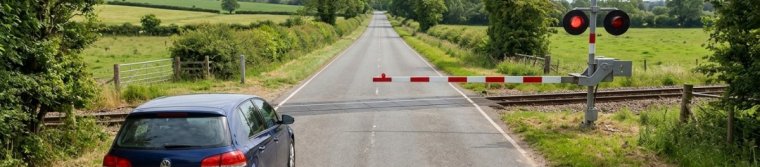
When the lights flash or the gates come down
Flashing red lights at a crossing mean you must stop and wait.
Do not cross until the red lights stop flashing, even if the gate rises.
When the crossing devices or a person warn you a train is coming, stop at least 15 feet from the nearest track.
Never drive under lowering gates or around lowered gates.
If the gates are down and you do not see a train, call the railroad emergency number posted at the crossing or 911.
Stop, look and listen
Even at crossings with gates, use your own eyes and ears.
- Turn down the radio and open a window if you need to listen.
- Look in both directions, even after a train passes.
- Expect a train on any track, at any time, traveling in either direction.
- Remember that many crossings have more than one track.
A second train can be hidden behind the first one.
Wait until you can see clearly down the tracks in both directions before you go.
Never stop on the tracks
The handbook is firm about this point.
Never stop on the railroad tracks.
Do not start across unless there is enough room on the other side to completely clear the tracks.
Traffic backups near crossings are a common trap.
A car that crosses and then has to stop with its rear end over the rails is in serious danger.
If the line of cars ahead is not moving, wait behind the stop line until there is space.
Vehicles that always stop
Some vehicles must stop before every railroad crossing.
These include buses, school buses and vehicles carrying a hazardous materials placard.
When you follow one of them toward a crossing, expect it to stop even if no train is coming.
Leave extra space and do not try to pass it there.
Light rail tracks in the city
Many cities have light rail lines running on public streets.
Light rail vehicles have the same rights and responsibilities as other vehicles.
Never turn in front of an approaching light rail vehicle.
Check for one before you turn across the tracks, and complete your turn only when the signal allows it.
Our guide to left turns, right turns and U-turns covers turning habits in more detail.
A quick checklist
- Yellow lights on a school bus: slow down and prepare to stop.
- Red lights on a school bus: stop from either direction and stay stopped.
- Near schools: 25 mph within 500 feet when children are present, sometimes 15 mph.
- Obey crossing guards every time.
- At railroad crossings: look, listen and expect a train on any track.
- Stop at least 15 feet from the nearest track when a train is coming.
- Never go around gates and never stop on the tracks.
The bottom line
School buses, school zones and railroad crossings all ask for the same thing: patience.
Slow down early, stop when the rules say so and wait until the way is truly clear.
A few seconds of waiting is always cheaper than a mistake in these places.
Sources and Further Reading
- California DMV: California Driver Handbook, Section 7, Laws and Rules of the Road (Continued) — supports the school bus rules and penalties, the school zone speed limits, the blind intersection and alley limits, the railroad crossing rules and the vehicles that must stop at crossings.
- California DMV: California Driver Handbook, Section 7, Laws and Rules of the Road — supports the meaning of the railroad crossing signs, the blue and white emergency sign, the five-sided school sign and yellow school crosswalks.