
Rear-end collisions are some of the most common crashes on any road.
Most of them share one simple cause: the driver behind was too close to stop in time.
Following distance is the space between your car and the vehicle ahead.
It is the cheapest safety feature you will ever have, and it works on every car, old or new.
This guide explains the three-second rule, when to leave even more room and how to handle drivers who crowd you.
Why the gap matters so much
Stopping a car is never instant.
First you have to notice the problem, then move your foot to the brake, then wait for the car to slow down.
Each of those steps uses up road.
At highway speed, a car travels more than 100 feet every second.
If the car ahead brakes hard and you are too close, the space simply runs out before you can stop.
The California Driver Handbook lists two problems with tailgating.
It blocks your view of the road ahead, because the vehicle in front hides what is coming.
It also leaves you without enough time to react if that driver brakes suddenly.
A safe gap gives you time to react when another driver makes a mistake.
How to use the three-second rule
The California handbook recommends the three-second rule to keep a safe following distance.
The idea is to measure your gap in time, not in car lengths.
A time gap grows on its own as your speed rises, so it works at 25 mph and at 65 mph.
Here is how to check it:
- Watch the vehicle ahead pass a fixed object, such as a sign, a tree or a bridge shadow.
- As its rear bumper passes the object, start counting: one thousand one, one thousand two, one thousand three.
- If your front bumper reaches the object before you finish counting, you are too close.
- Ease off the accelerator, let the gap grow and count again.
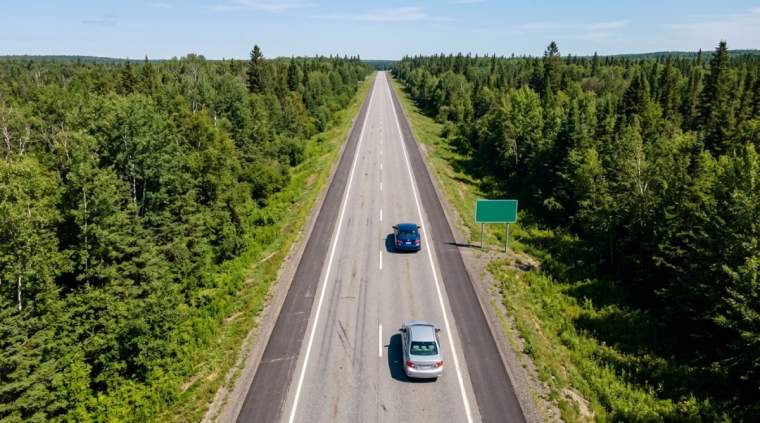
Practice this a few times on a familiar road.
You will soon learn what a three-second gap looks like at different speeds.
When three seconds is not enough
Three seconds is a minimum for good conditions.
Many situations call for much more room.
Wet, snowy or icy roads
The California handbook says to drive more slowly on slippery roads and allow more space ahead.
It gives clear speed guidance for different surfaces:
- Wet road: reduce your speed by 5 to 10 mph.
- Packed snow: reduce your speed by half.
- Ice: slow to no more than 5 mph.
Your stopping distance grows a lot on these surfaces.
Doubling your following time, or more, is a sensible habit when the road is slick.
Poor visibility
In heavy rain or snow, you may not see more than 100 feet ahead.
The California handbook says that when you cannot see farther than 100 feet, it is not safe to drive faster than 30 mph.
The same handbook advises increasing your following distance in heavy fog or smoke.
Other times to add space
- When a tailgater is behind you, so you have room to slow gently.
- When following motorcyclists on metal bridge gratings, railroad tracks or gravel, as the handbook notes.
- When following large trucks or buses that block your view of the road.
- At night, when hazards are harder to see.
- When you are tired, distracted or driving an unfamiliar vehicle.
- When towing a trailer or carrying a heavy load that lengthens your stopping distance.
Look far ahead, not just at the bumper in front
Following distance works best when you also look well down the road.
The California handbook advises scanning the road at least 10 seconds ahead of your vehicle.
That way you see brake lights two or three cars ahead before the driver in front reacts.
You can then slow down smoothly instead of braking hard.
Smooth braking also helps the driver behind you, who gets more warning.
When someone cuts in front of you
On busy roads, other drivers will slide into the gap you leave.
It can feel frustrating, but closing the gap tightly is not the answer.
The California handbook gives a simple instruction for this moment.
If a vehicle merges in front of you too closely, take your foot off the accelerator.
That creates space between you and the new vehicle ahead.
Then rebuild your three-second gap and carry on.
You will lose a second or two, which is nothing on most trips.
How to handle a tailgater
A driver riding your bumper is a real hazard.
If you have to stop suddenly, that driver may not be able to stop in time.
The California handbook advises staying calm and predictable.
- Maintain your course and speed instead of braking to send a message.
- Increase the space in front of your car, so any stop you make can be gradual.
- When it is safe, signal, check your blind spot and move to the right lane.
- Let the tailgater pass, then continue at your own pace.
Avoid brake-checking, gestures or speeding up to get away.
Those reactions can turn a minor annoyance into a road rage incident or a crash.
On a two-lane road with no room to move over, look for a safe place to pull off and let the driver go by.
Keep space on the sides too
Space around your car matters on every side, not only in front.
The California handbook advises against staying in another driver's blind spot.
It also says to avoid driving directly alongside other vehicles when you can.
Leaving room on the sides gives you an escape path if something happens ahead.
It also makes space for drivers entering the freeway, even if you have the right-of-way.
Following distance when merging
The three-second idea also applies when you join a highway.
The California handbook says to make sure you can stop safely by leaving three seconds of space when you merge.
Choose a gap large enough for your car, match the speed of traffic and settle in with a full cushion ahead.
Common following-distance mistakes
- Judging the gap in car lengths instead of seconds.
- Keeping the same gap in rain, snow and darkness as on a dry, sunny day.
- Closing the gap so no one can merge in front.
- Staring only at the car directly ahead and missing brake lights farther up.
- Braking hard to punish a tailgater instead of moving over.
- Relying on driver-assist systems to keep the distance for you without paying attention.
The bottom line
A safe following distance is one of the simplest ways to avoid a crash.
Use the three-second rule as your minimum, and add more time in bad weather, darkness and heavy traffic.
Look far ahead, ease off when someone cuts in, and let tailgaters pass instead of fighting them.
A few extra seconds of space can be the difference between a hard stop and a collision.
Sources and Further Reading
- California DMV: California Driver Handbook, Section 8, Safe Driving — supports the three-second rule, the risks of tailgating, scanning 10 seconds ahead, handling cut-ins and tailgaters, side space, extra space for motorcyclists, and the speed guidance for wet, snowy, icy and low-visibility roads.
- California DMV: California Driver Handbook, Section 6, Navigating the Roads — supports the advice to leave three seconds of space when merging onto a highway and to merge into a gap large enough for your vehicle.