
Few moments behind the wheel are as frightening as brakes that do not behave.
Sometimes the wheels lock and the car slides straight ahead no matter how you steer.
Other times the pedal feels soft and sinks toward the floor.
Both situations call for quick, calm action.
The right response depends on the braking system in your car.
This guide explains how to brake smoothly in normal driving, how to handle a locked wheel skid and what to do if the brakes fail.
It is based on the California Driver Handbook. Your owner's manual has the details for your exact vehicle.
Start with smooth, early braking
The best brake emergency is the one that never happens.
The California Driver Handbook describes a simple way to stop.
Take your foot off the accelerator and let the car begin to slow down.
Then press the brake lightly until you come to a full stop.
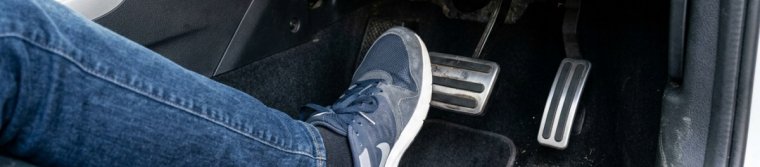
Give yourself enough space and time to do it gently.
Hard, late braking is what usually locks the wheels.
Looking far ahead helps you avoid it.
The handbook advises scanning the road at least 10 seconds ahead of your vehicle.
That way you see trouble early and can slow down gradually.
What a locked wheel skid is
A skid happens when one or more tires lose their grip on the road.
A locked wheel skid is a specific kind of skid.
The handbook says it is usually caused by braking too hard while going too fast.
When the wheels lock, they stop turning and simply slide.
A sliding tire cannot steer.
The handbook warns that the car will skid no matter which way the steering wheel is turned.
The goal is to get the wheels rolling again so you can steer.
First, know which brakes you have
Most newer cars have an antilock braking system, usually called ABS.
ABS is designed to keep the wheels from locking during hard braking.
Some vehicles have ABS on all four wheels, some only on the rear wheels, and older vehicles may have none.
The handbook says to check your owner's manual to find out whether your vehicle has ABS.
Do this now, on a calm day, not in the middle of a skid.
The correct reaction is different for each type.
If your car has four-wheel ABS
With ABS on all four wheels, the advice is simple.
The handbook says to apply firm pressure on the brake pedal.
Keep that pressure steady and let the system do its job.
Do not pump the pedal. Pumping works against the system.
Steer where you want to go.
ABS is meant to keep the wheels rolling, so you can usually still steer while braking hard.
Your owner's manual explains what ABS feels and sounds like when it works in your car.
If only the rear wheels have ABS
Rear-wheel ABS is common in light trucks.
The handbook gives two steps for a locked wheel skid with this system.
- Ease up on the brake pedal, keeping just enough pressure to let the front wheels roll again so you can steer.
- Stop braking and turn the steering wheel in the direction of the skid.
The key is releasing enough pressure that the front tires grip again.
If your car has front-wheel ABS
The handbook describes a slightly different response for front-wheel ABS.
- Take your foot off the brake pedal to unlock the wheels.
- Steer in the direction you want to go.
- Straighten the front wheels as the vehicle begins to straighten out.
If your car has no ABS
Without ABS, holding the pedal down hard can keep the wheels locked.
The handbook says that if a car without ABS begins to skid, quickly pump the brakes until you reach a safe speed.
Pumping lets the wheels turn briefly between presses, which gives you back some steering.
If the brake pedal sinks to the floor
A pedal that sinks is a sign that the brakes are not working as they should.
Stay calm and act quickly.
The handbook gives these steps:
- Quickly pump the brakes by gently applying and releasing pressure on the pedal.
- While pumping, shift into a lower gear, or into neutral, to help slow the car down.
- Then try using the emergency brake to stop.
Apply the emergency brake with care.
Using it gradually helps you keep control while the car slows.
While you work the brakes, keep steering.
Turn on your hazard lights and use the horn to warn people around you.
Look for a safe place to steer toward, such as a shoulder, an empty lane or an uphill road.
Once you stop, do not drive the car again.
Have it towed to a repair shop and inspected before it goes back on the road.
When the brakes get wet
Driving through deep water can soak the brakes and make them weak.
The handbook explains how to dry them.
Lightly press the accelerator and the brake pedal at the same time.
Do this only until the brakes are dry.
Its advice on flooded roads adds a related step.
If you have no choice but to drive through water, test your brakes afterward to make sure they work correctly.
The best plan is still to avoid flooded roads entirely.
Our guide to flooded roads explains why.
Preventing skids on slippery roads
Many locked wheel skids start on wet, icy or snowy pavement.
The handbook's safe driving section gives clear speed guidance for slick roads.
- Wet road: reduce your speed by 5 to 10 mph.
- Packed snow: reduce your speed by half.
- Ice: slow to no more than 5 mph.
It also advises slowing down before intersections and curves.
Avoid fast turns and quick stops.
Shift to a low gear before you go down a steep hill.
Leave plenty of space between you and the vehicle ahead.
More space means you can stop gently instead of slamming the pedal.
For more on winter skids, see our guide to driving on snow and ice.
Warning signs worth checking
Brake problems often give some warning before they become an emergency.
A soft or spongy pedal, a car that pulls to one side when you brake or a brake warning light all deserve attention.
So do squealing or grinding noises when you stop.
If you notice any of these, have a qualified mechanic check the brakes soon.
Do not wait for the next long trip.
A quick brake emergency checklist
- Know whether your car has four-wheel, rear-wheel or no ABS.
- With four-wheel ABS, press firmly and steer.
- Without ABS, pump the brakes quickly until you reach a safe speed.
- If the pedal sinks, pump it, downshift and try the emergency brake.
- Use hazard lights and the horn to warn others.
- Dry wet brakes by lightly pressing the accelerator and brake together.
- Have any brake problem inspected before you drive again.
The bottom line
Smooth, early braking keeps most drivers out of trouble.
When the wheels lock or the pedal fails, the right move depends on your braking system.
Learn which one you have today, so your hands and feet already know what to do.
Sources and Further Reading
- California DMV: California Driver Handbook, Section 8, Safe Driving — supports the causes of locked wheel skids, the responses for four-wheel, rear-wheel, front-wheel and no ABS, the steps when the pedal sinks, drying wet brakes, testing brakes after flooded roads and the speed guidance for slippery roads.
- California DMV: California Driver Handbook, Section 6, Navigating the Roads — supports the smooth braking method and leaving enough space and time to stop.